
If you think you know all you need to know about former Secretary of Defense Donald Rumsfeld, I assure you that you do not, and likely never will. If you want to try, however, a good place to start is by watching the one-sided bio documentary The Unknown Known. It is well produced, intriguing, and even fun to watch. That said, approach with caution. It is easy to find yourself caught in Rumsfeld’s friendly, innocent old man appeal, complete with front porch rocking chair charm and “darned if I know” deflections. Make no mistake about it. He is complex, his actions are premeditated, and he is smart enough to understand the space between us and the other side of the screen.
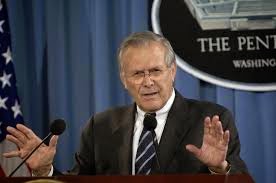 From the very beginning, Rumsfeld appears to be on trial. He opens by questioning whether he should even read aloud a personal memo he is about to share, offering an involuntary sense of hesitation. “You want me to read this?” he asks, wearing a face of obligation. He then proceeds, “All generalizations are false, including this one,” squinting and smiling. It is the line that opens the film and sets its tone. It is also the line Rumsfeld clearly understands as validation for every good and bad decision he has made throughout his career, offering atonement for all the rights and wrongs he is about to recount.
Criticisms of Rumsfeld aside, the film itself is excellent. The editing is sharp, the graphics engaging, and Rumsfeld’s stories are as fascinating as he is. As the film unfolds his long history in public service, I found myself in awe of his bold maneuvering during the Ford administration and his early collaboration with Dick Cheney, moves that would later contribute to the controversial shakeup known as the Halloween Massacre. At times, it felt like I was watching a real life episode of House of Cards, which both unsettled me and pushed me to look more deeply into who this man really is. As the story progressed, I gained a clearer understanding of his decisions surrounding 9/11, the War on Terror, military torture, and ultimately his resignation in 2006.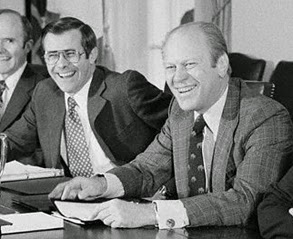
In the end, I remain critical of Rumsfeld as a leader in our history. I found myself tangled in his logic of the “knowns” and the “unknowns,” briefly seduced by the archive of personal memos and his disarming smile. In truth, I believe he may be confused by his own reasoning. His logic feels twisted enough to help him reconcile his role in history and the deeply unsettling events that occurred under his leadership.
Spoiler alert. In the film’s closing moments, director Errol Morris ends the story exactly where it began. Once again, Rumsfeld is placed on the stand as Morris asks from behind the camera, “Why are you doing this?” Rumsfeld responds, “I’ll be darned if I know.” And I’ll be darned if he doesn’t.
TRAILER

No comments:
Post a Comment
Note: Only a member of this blog may post a comment.